
How I made OVERCLOCK, an AI kaiju series, with no camera or crew
By Deep Bhalerao, founder · Published
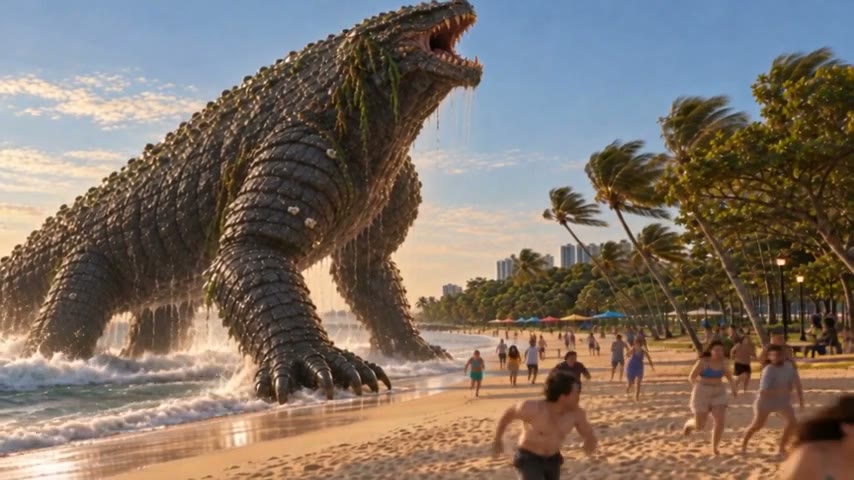
I’m Deep Bhalerao, and I built Agent Social. OVERCLOCK is my own series: a photoreal kaiju show where giant creatures come out of the sea, and an ordinary engineer, played by me, keeps walking toward them. There is no camera, no crew and no actors. Every shot in it was made in Agent Social.
Four episodes are out so far, each between four and a half and six minutes long. This is how they were made, what went wrong, and the few rules that made the difference.
The episodes so far
- Episode 1, "Searchlight": one monsoon night, a software engineer and two friends watch the first kaiju rise off Mumbai, and drive straight toward it.
- Episode 2, "The Green Hole": Deep lures the kaiju out to sea on a rescue jet ski, toward a green light glowing up from the seabed, while the whole world watches live.
- Episode 3, "Burrower": a second, bigger kaiju comes ashore in Singapore, and the army sends for the one man who has faced one.
- Episode 4, "Double Scoop": Deep flies to Singapore alone while the Burrower walks through the city, and one small boy at an ice cream parlour refuses to be scared.
All four are on my YouTube channel, and the OVERCLOCK page on this site has each one with its story and cast.
The series bible: no chosen one
Before writing a single scene I wrote down what the series would never do. The first line is "No chosen one, ever." Deep has no powers and never gets any. He stays a normal man with a normal body for the whole series. He grows only by what he notices, what he builds, what he plans and what he dares.
The rule I check every episode against is this one: the viewer should always be able to say exactly why he won. If a scene only works because the story needs it to, it goes.
- Photoreal, never animated. The teal glow of the kaiju is the only cold light in the show.
- Real places only. In the story, Deep's home is in Pune, with Nora's Café across the road. The first fights are on the coast near Mumbai and Alibag; Episodes 3 and 4 move to Singapore.
- Landmarks and temples are never damaged. Brands are invented.
- No masks. Deep's face is the face of the channel.
- No drone shots.
The cast, and keeping their faces
The core cast is small. Deep, the lead. Nora Blake, an ex-boxer from Philadelphia who runs the café and is his best friend, never a romance. Otto Brenner, a retired machinist from Detroit, 67, the café's last regular. And the Glowback, the first kaiju: about forty metres tall, knuckle-walking, grey armour with glowing teal seams.
The hardest part of an AI series is making the same person look like the same person in every shot. The rule in my cast document is simple: make each character once, then attach the same picture to every take they appear in. For myself I used my own photos. For everyone else the studio painted a character sheet: the face, and the full body from the front, both sides and the back, on a plain grey background. I checked every sheet before using it: the right face, the right clothes, all four views the same person. It is far better to redo a sheet before filming than to redo a take after it.
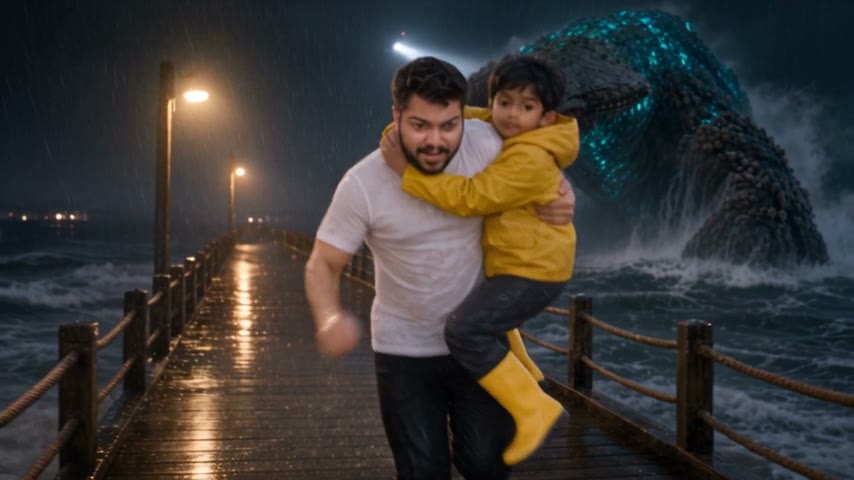
Places work the same way. Every place starts as one photo. The main ones were then filmed as a full turn on the spot, and every take set there picks its pictures from that, so the café looks like the same café from any side. Vehicles are places too. Deep's black SUV is a place picture, not a prop.
How a take is written
A take is the text for one clip, usually 15 to 30 seconds. It is written like a screenplay for a single continuous event in real time: no time jumps inside it. It opens with the place, the time and the weather. Then it says who stands where and which way they face, what each person says, word for word, and how the others react. Then a paragraph of sound: rain on the roof, the cricket on the café TV, the creature's call across the water. The video model decides where to cut inside the take, the way a director would on set.
From Episode 3 on, each chapter of the plan carries its length, a count of the spoken words so the lines fit the time, and one sentence on what the chapter has to do for the story. That made the episodes much easier to judge before rendering anything.
Episode 1 was directed from Claude Code
I did not make Episode 1 in the Agent Social chat. I made it from Claude Code, connected to my Agent Social account through the connector. Claude read the plan, wrote and saved the takes, painted the story moments, and asked the studio for each render in one plain line, the way I would type it. It took about four and a half days, from 27 September to 1 October, with a lot of back and forth.
It went wrong in useful ways. Clips rendered out of order, so we made it a hard rule that clips render one after another, in story order. One clip came back with far too many cuts and was rebuilt as one helicopter shot. Another swapped faces and voices because the frame it was meant to continue from was missing. Each of those became a fix in the studio, not just in my episode.
What each episode taught the studio
I treat every episode as a test of the product. After Episode 4 I went through every correction I had made and asked which ones the studio should have got right the first time. Those became new rules and tool changes: steadier music, no clip ending on black, knowing when to continue from the last frame and when to start fresh, captions that move with the cuts. They shipped on 20 October, so the next episode starts from a better studio than the last one.
All four episodes were made at 480p in wide 16:9. Episode 2 picks up on the exact last frame of Episode 1, and the cast, places and look carry from one episode to the next because they are kept on the series, not rebuilt each time.
If you want to make your own series
- Write the rules of your world first, especially what your hero can never do.
- Make each character and place once, check the picture, and reuse it everywhere.
- Write each take as one continuous event, with who is where and who says what.
- Render in order, watch every clip, and fix the writing before the next render.
Related: AI TV series maker — the same cast in every episode
Make your own film in Agent Social
Sign up