
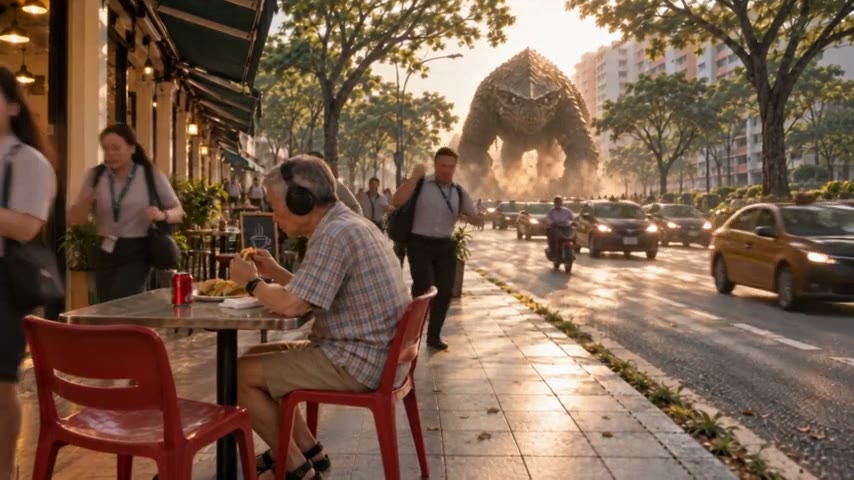
A story generator gives you words. Agent Social gives you a filmed episode: you type the idea, read the plan, and the studio writes, casts and films it, then carries on into the next one. Here is the whole path, from one line to Episode 2, the way I made OVERCLOCK.
How do you turn an AI story idea into a finished episode?
In Agent Social, you type the idea, read the story the studio writes from it, check the cast and places, and then watch the episode filmed in order. One sentence is enough to start: who the story is about and what goes wrong. The studio plans it as chapters, each a scene, writes the dialogue, and shows you everything before a single clip is filmed. You change anything in plain words: a darker ending, a shorter scene, a line that sounds more like your character. When you approve, every clip is filmed one after another with its voices and scene sound, and the clips are joined into one film you can download as an MP4. The idea does not have to be good yet. It has to be specific enough to start, and the plan is where it gets good.
Write the idea
One line: who, where, and what goes wrong.
Set up the series
A short brief for the look, the world and the people, written once.
Read the plan
Chapters and dialogue, changed in plain words until it reads right.
Check the cast and places
Each one is made once as a picture, so every clip uses the same faces.
Film Episode 1
Clips are filmed in story order and you watch each one as it lands.
Start Episode 2
It opens where Episode 1 ended, with the same cast and places.
What is a series bible, and do you need one for an AI story?
A series bible is a short written description of your show that every episode inherits, and in Agent Social it is worth five minutes before Episode 1. You do not need one for a single film, but a series without one drifts. Mine for OVERCLOCK has five short parts: the show (what it is about and who it follows), the look (extreme photorealism, like real footage from a big monster film), the frame (wide and horizontal), the world (present day, the monsoon, the west coast of India) and the people. It also holds the few rules that make the show itself, such as that Deep has no powers, ever. Write yours as plain sentences, not a template. The AI TV series guide shows how the brief travels with every episode.
Which story ideas work well as AI series?
Ideas with a small cast, a clear place and a question that needs another episode to answer. In Agent Social, the people and places you make once are reused in every episode, so a story built around a handful of faces and a few recurring rooms gets cheaper and better as it goes. A new viewer should understand the premise in one sentence, and every episode should end on a turn that makes the next one worth watching. Genre helps because it tells the studio the look and the pace at once: a detective story wants night and wet streets, a family comedy wants one warm kitchen. The cards below are ready to start from, and each line can be typed as it stands or changed to fit you.
The Last Tram
A Kolkata inspector investigates what happened on the final tram of the night. One suspect, one carriage and one new clue per episode.
“Start a detective series called The Last Tram: a Kolkata inspector works out what happened on the final tram of the night, one clue per episode. Photoreal, moody, 4 to 5 minutes each.”
Signal From Deck Nine
A small crew on a deep-space freighter hears a message that should be impossible. A small cast and one set make it easy to carry across episodes.
“Start a sci-fi series called Signal From Deck Nine: a six-person freighter crew receives a message that cannot be real. Photoreal, tense, 5 minutes each.”
Three Sisters and a Bakery
Three sisters run a bakery in Pune and every episode starts with one ruined order. One kitchen, warm light and a lot of dialogue.
“Start a family comedy series: three sisters who run a bakery in Pune, each episode starting with a ruined order. Warm, funny, 3 to 4 minutes each.”
Chai Aur Chitthi
A postmaster in a hill town finds a letter that was never delivered and tries to find its owner. Everyday Hindi mixed with English, English subtitles.
“Start a Hindi drama series called Chai Aur Chitthi: a hill-town postmaster tries to deliver one letter that was never delivered. Everyday Hindi with English, English subtitles, 4 minutes each.”
How do you get from the series bible to Episode 1?
Ask for Episode 1 in a sentence, and the studio writes it as chapters that fit the world you described. In Agent Social, each chapter is one scene, made of one or more clips, and a clip runs from 4 to 30 seconds on Seedance 2.5, the default video model. Then you meet the cast and places as pictures before anything is filmed. Check every face and every room, because a wrong picture costs one redraw now and a drifted face costs every clip later. You can play a character yourself from your own photos, which is how I play Deep. In OVERCLOCK, Episode 3 is twelve chapters and fourteen clips, close to six minutes long, and its plan went through about 350 rounds of changes in the studio chat before anything was filmed.
How do you check the story before anything is filmed?
Read the plan the way a viewer would watch it, and ask for changes in plain words until it reads right. In Agent Social, nothing is filmed until you ask for it, so this is the cheapest place to fix anything. Look for scenes that repeat, lines that do not sound like the person speaking and an ending that does not turn. Fixing a sentence costs a moment, and fixing footage costs a clip. For a deeper look, the guide to writing a screenplay for AI video shows what each scene should hold. Then check that the cast and places are right. Each one is a picture you can approve or ask to redraw, and every clip uses the pictures you approved. Only when the plan and the pictures both look right should you ask for the first clip.
How does Episode 2 continue from Episode 1?
In Agent Social, you start the next episode from the one before, and the studio asks one question: "What should this episode be about?" Answering is optional. Say what happens, or leave it blank and the studio proposes the episode itself. Under it is one switch, "Continue straight on, with no cut". Turn it on and the first shot of the new episode picks up from the last shot of the old one: the same moment, clothes and light. The cast and places carry over either way. OVERCLOCK does this every time. Episode 3 ends at a breakfast table near Alibag with an air force helicopter on the lawn, rotors still turning, and Episode 4 opens on that exact frame, with only Deep leaving while Nora and Otto stay behind and watch.
What does a finished AI episode cost?
A finished episode costs what its finished minutes cost: from $25 per finished minute, up to 1080p. A five-minute episode starts from $125. In Agent Social, it is pay as you go, with no subscription and no free plan, and the credits you do not use never expire. A redone clip is filmed again and adds to the total, so read the plan carefully first, and settle the story in words before you film. The price follows the finished length, which makes an episode easy to budget. A five-minute film can be done in two to three hours. See what an AI episode costs for the full breakdown, or try the calculator below.
| Finished length | Starts from |
|---|---|
| 1 minute | $25 |
| 5 minutes | $125 |
| 20 minutes | $500 |