
To make an AI horror short film, pick one place and one frightening idea, build dread with what the audience can sense but not see, let the sound do half the work, and hold the reveal until the last moment. Agent Social makes it in one chat, clip by clip. Keep it tasteful and keep every person in danger an adult.
What makes a horror short film scary without gore?
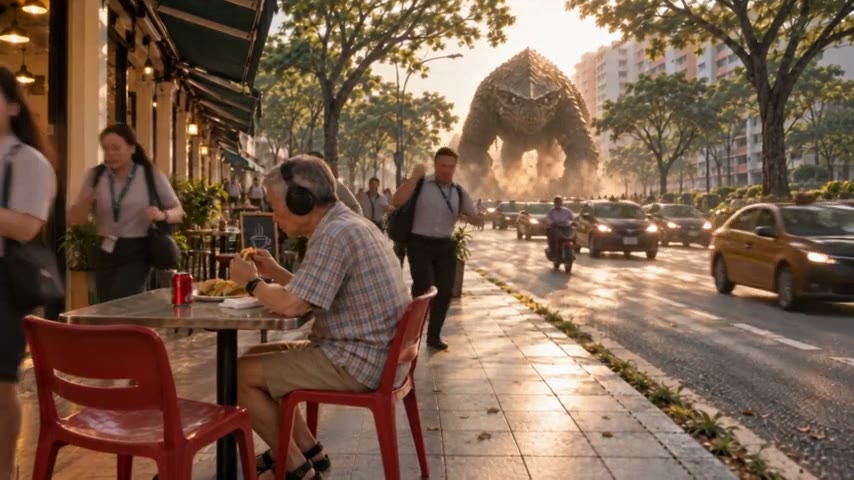
Dread makes it scary: the audience knows, or suspects, something is wrong before the character does. Gore shocks once, but dread keeps building as long as the question stays open. In Agent Social, you build dread by describing what the person notices, such as a door that was closed and is now open, and by deciding what the camera does not show. The frame below is from my sci-fi series OVERCLOCK, which is not a horror film, but it shows the principle exactly: a man eats with his headphones on while something enormous stands behind him. The viewer sees it, he does not. For the whole path from idea to finished film, see turning a story into a short film.
Why is sound half of a horror film?
Sound is half the scare because the ear imagines what the eye is not shown. A floorboard, a breath, a distant door and a silence that goes on one second too long frighten more than any picture. In Agent Social, every clip comes back with the sound of the place already in it, so a cellar sounds like a cellar and rain sounds like rain. Dialogue arrives spoken in each character’s own voice. When the clips are joined, ask for music in plain words, such as “a low drone, almost silent, rising slowly”, and ask for it quieter under speech or at a given moment. Learn more about AI video with sound and adding music, voices and subtitles.
Why should a horror short film stay in one location?
One location keeps the audience trapped with the character, and it makes the film far easier to keep consistent. In Agent Social, each place gets its own pictures, and a place you film from several sides gets a view from each, so a hallway looks like the same hallway from the door and from the stairs. A short film of three to five minutes is a good size for one place, one idea and a small cast. Every extra place is another set of pictures to check. Use the place itself as the threat: the long corridor, the stairwell with one working light, the farmhouse kitchen at night. Make the audience learn the layout, then change one thing in it.
How do you build a reveal that lands?
Delay it, hint at it, and then show less than the audience fears. First the sign, such as a sound or a shadow. Then a glimpse, such as a hand on a door frame or a shape at the end of the corridor. Only then the whole thing, and often a half-second is plenty. In Agent Social, each stage can be its own clip, filmed in story order, so you can watch the build-up and decide whether the next clip should come sooner or later. Ask for a moment, a still of the beat, before filming, to check what is in the frame and what is not. If the reveal is too early, ask for the clip again; only that clip is filmed again, and the rest of the film stays as it is.
Normal
0:00Show the place and the person. Make the audience learn the room.
The sign
0:45One small wrong thing. A sound, a door, a light.
The wait
1:30Stay still. Let the silence work, with no music.
The glimpse
2:15A shape or a hand, held for a moment. Nothing explained.
The reveal
2:45Show it briefly, then cut to black on the sound.
What horror premises work for an AI short film?
The best premises are small, set in one place, and frighten with an idea rather than an effect. Use a single adult character, a single location, and a rule the audience can learn: the voice on the phone knows where you are, the lift stops on a floor that does not exist, the neighbour’s light is on in an empty house. Agent Social can film any of these, but the premise has to do the frightening. Avoid anything that puts a child in danger, and skip gore: the cards below are quiet, adult stories that work with a few minutes of film. Copy one into the studio and read the chapters before anything is filmed.
The back door
A door opens and closes and nobody comes in. The kitchen is the only set.
“A horror short in one farmhouse kitchen at night: a woman hears the back door open and close, but no one is there. Quiet, no gore, nothing shown until the last shot.”
Floor thirteen
A lift stops at a floor that is not on the panel. The doors stay open.
“A horror short inside an office building lift at night: a security guard’s lift stops at a floor that does not exist. Slow, quiet and tense, with no gore.”
The voice on the line
A caller knows what the woman in the room is doing. Only a phone and a window.
“A horror short in one apartment at night: a woman’s phone rings and the caller describes exactly what she is doing. Keep it quiet, no gore, and never show the caller.”
The security monitors
On the cameras, something is in a room that is locked from the inside.
“A horror short in a night-shift security room: a guard watches a monitor of a locked storeroom and sees someone moving. One location, no gore.”
The knock count
Three knocks, then silence, then three more, each from further round the house.
“A horror short in a remote cabin in the snow: a man counts knocks that move around the house, each one from a different wall. Quiet and slow, with no gore.”
The neighbour’s light
The window across the courtyard is lit in a flat that has been empty for a year.
“A horror short from one apartment balcony at dusk: a woman notices a light on in the empty flat opposite and slowly sees a figure move behind the curtain. No gore.”
Is your horror film ready to film?
It is ready when the answers below are yes, and the cheapest time to fix a miss is before a clip is filmed. In Agent Social, draft the whole film, the default, read every chapter, and film in order. When the film is final, upscale it to 1080p once. A character, a place and a voice are each made once and checked. If a clip misses, only that clip is filmed again, so a late fix to one scene never disturbs the others. Check the sound clip by clip as it comes back, because that is where horror succeeds or fails. If a scare is not landing, ask for one change in words, such as “make the room quieter” or “hold the shot two seconds longer”.
Is your horror short ready to film?
- Is the whole film set in one place?
- Does the audience sense something wrong before the character does?
- Have you planned the sound: what we hear and when it goes quiet?
- Is every person in danger an adult, with no gore planned?
Answer each question for your verdict.