
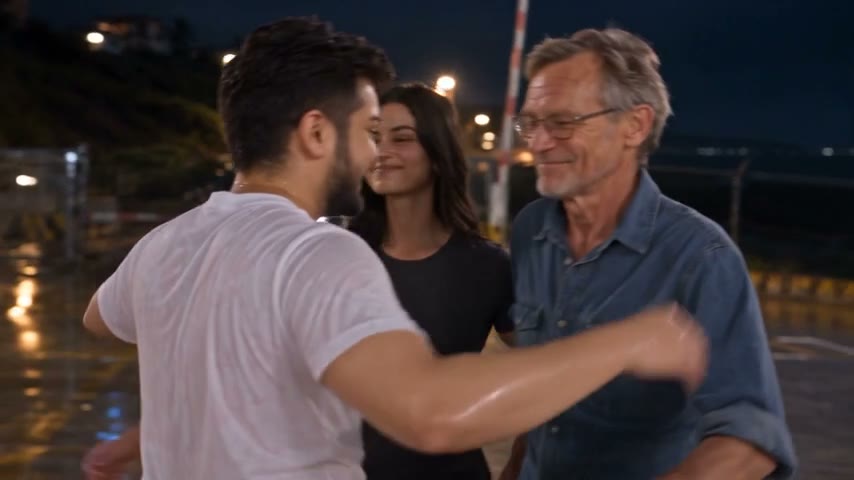
A beginner can go from nothing to a posted short film in seven days in Agent Social, one small job a day: a story, a cast, filming in order, sound, a finished cut and a post. You do not need a camera, a crew or a course. You need a one-minute idea and the habit of watching every clip. This plan is built for the AI short film maker.
What is AI filmmaking, and can a beginner do it?
AI filmmaking is directing a film in words: you decide the story, the people and the places, and an AI studio films it while you judge every shot. A beginner can do it, because the hard part is not a tool but finishing. In Agent Social you describe the film in a chat, and the studio writes it, makes your characters and places once, and films every clip in story order. I made all five episodes of OVERCLOCK that way, alone. The skills you are learning are the old ones, story and directing, which is why becoming an AI filmmaker is mostly about practice, and why one short film teaches more than a month of watching tutorials.
What does a 7-day AI filmmaking plan look like?
It is one small job a day, and each one ends with something you can look at. Day 1 is the story, Day 2 the cast and places, Days 3 and 4 the filming, Day 5 the sound, Day 6 the finished cut and Day 7 the post. The order matters: you fix problems in words before you fix them in footage, and you film in story order so every clip carries on from the last. Your film is one minute long, set in one place with two characters, so nothing in it is too big to finish. The timeline below is the whole week; the sections after it explain the days that trip people up.
Write one line of story
Day 1One place, two characters, one problem and one turn. Type it to the studio, then read the chapters and the screenplay of every clip and change what is wrong, in plain words.
Check your cast and places
Day 2The studio makes each character and place once. Look at every face. You can use a few of your own photos for a character, and clone a voice from a recording of 15 seconds or more.
Film the first clips
Day 3Clips run from 4 to 30 seconds. Film clip 1, watch it, say what is wrong in one sentence and film it again if needed. Only then film clip 2.
Finish the scene
Day 4Film the rest in order. Dialogue and scene sound arrive inside each clip, so you are already judging how it sounds.
Add music and subtitles
Day 5Once the clips are final and joined, ask for music and subtitles over the whole film at once.
Watch it cold and upscale
Day 6Watch the whole film with fresh eyes, fix one thing, then upscale to 1080p in one click. Why you draft first and upscale at the end.
Download and post
Day 7Download the MP4 and upload it wherever your audience is. Turning your film into shorts and posts covers the next step.
What should you make on Day 1?
Make a one-minute scene with one place, two characters and one turn at the end, such as two neighbours in a lift when the lights go out and one of them says something that changes the other’s mind. A minute is a handful of clips, so it is small enough to finish and long enough to test everything. Keep it in one place and one stretch of time: no jumps, no crowds, no second location. Write it in a sentence or two and let the studio plan the chapters. If you already have a script, paste it and ask the studio to keep your lines as written. Then read every clip before anything is filmed, because a sentence fixed on Day 1 costs nothing and a clip filmed twice costs a retake.
How do you keep the same faces all week?
You keep the same faces by making each character once and reusing them, which is what Agent Social does with the cast you approve on Day 2. Every later clip is filmed from those same pictures, so your two neighbours look like themselves in clip 1 and in clip 6. Your job is to look hard at the faces on Day 2, because a face fixed once is right in every clip. If you are playing the lead, a few of your own photos become the character. The full method is in keeping the same face in every shot, and consistent characters shows how it holds across a whole series, not only a one-minute short.
Do you need an AI filmmaker course first?
No. A course can explain the ideas, but you learn them by finishing a film, and a one-minute short is the cheapest course there is. Each of the seven days teaches one skill: Day 1 story, Day 2 casting and continuity, Days 3 and 4 directing and pacing, Day 5 sound. The studio does the heavy work, so what you practise is judgement: is the line right, did the face hold, does the scene turn? If you want more structure afterwards, make a three-episode series with the same cast, then a trailer. Agent Social is a studio, not a course, so the lesson is the film you finish this week and the one you make after it.
Watching lessons first
- Hours of theory before anything is made
- No finished film to learn from
- Easy to feel ready and never start
Finishing one short in seven days
- One small job a day, each ending in something to watch
- Every mistake caught on a clip, where it is cheap to fix
- A posted film by Day 7 and a clear next project
What does a first week of AI filmmaking cost?
You pay per minute of finished film: from $25 a finished minute, up to 1080p. A one-minute short is therefore from $25, plus some credits for the writing and pictures before filming. There is no free trial and no free credits, and the smallest top-up is $100. The cheapest week is the one where you read every clip before you film it. What an AI episode costs has the worked prices, and the pricing page has the slider. Retakes are billed like first takes, so use Days 1 and 2 to settle the words and the faces before any clip is filmed.
1 min
is the length of your first film
4–30 s
per clip, with dialogue and scene sound
7 days
from first idea to a posted film
Are you ready to start your 7 days?
You are ready if you have one small story, a willingness to watch every clip and a place to post. You do not need to be good yet; you need to finish. The check below asks four quick questions about your first film. If every answer is the right one, open the studio and start Day 1 today. If one is not, the answer tells you the small change that fixes it, and it is almost always a smaller story. OVERCLOCK Episode 3 runs 5 minutes 42 seconds across 14 clips, and it began as a story that was settled in words. Yours begins with one minute.
Is your first film small enough to finish this week?
- Does your story fit in one place?
- Does it have only two main characters?
- Can you say the turn at the end in one sentence?
- Does the story skip across days or years?
Answer each question for your verdict.