
To make an AI monster movie, design one creature, show its size against ordinary things, hold it back until the people on screen have reacted, and let every clip raise the stakes of the one before. You can do all of it in one Agent Social chat. My kaiju series OVERCLOCK is the worked example.
What makes an AI monster movie feel real?
A monster movie feels real when the creature obeys the same rules as everything around it: it has weight, it is lit by the same sun, and the world answers it. In Agent Social, you get that by describing the creature once, in plain physical words, then checking its pictures before any clip is filmed. OVERCLOCK’s Burrower is a digger with two thick hind legs and huge clawed hands, as tall as a thirty-storey building, and it looks the same in Episodes 3, 4 and 5 because it was made once and reused. The long-form AI video studio then films it in the places you describe. A creature that is only ever shown in empty sky looks like a graphic. A creature with a street, a car park and a crowd around it looks like a monster.
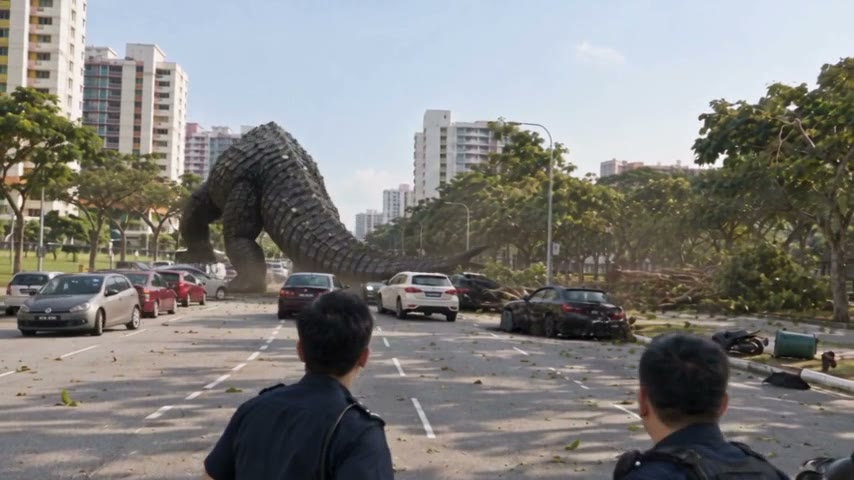
How do you show a creature’s scale on screen?
You show scale by putting things of known size next to the creature, and by filming from where a person would stand. A tree, a lamp post, a row of parked cars and two police officers in the foreground tell the eye how big the claws are without a single number. In Agent Social, describe the spot the camera is in, such as behind two officers in a car park, and name the buildings in view. Keep the creature partly cut off by the frame or by something in front of it, because an object that does not fit in the picture is read as huge. Avoid floating, drone-style views from above, which flatten everything to a map. OVERCLOCK has a rule against drone shots for exactly this reason: ground level makes the Burrower enormous.
Creature alone in the frame
- Empty sky or empty field behind it
- Nothing to measure it against
- Viewed from above, like a map
- Looks like a nice picture
Creature with the world around it
- Cars, trees and towers in the same shot
- Two or three people in the foreground
- Filmed from street level, looking up
- Looks like something that could step on you
How should you reveal the monster?
Reveal it in three stages: a sign, a glimpse, then the whole creature. First something small goes wrong, such as people looking the same way or a car alarm in the distance. Then a part appears, a claw or a tail over the rooftops. Only then do you show all of it. In Agent Social, each stage can be its own clip, filmed in story order, so the build-up is real. In OVERCLOCK’s Episode 4, the creature stands in the morning mist at the end of a road while a man at a pavement café eats his taco with headphones on and does not notice. Episode 5 pushes the glimpse further: its jaws come out of the smoke as one 30-second take, used whole. See how Episode 5 was made.
Why do the people matter more than the monster?
The people matter more because a monster is only frightening when someone in the frame is frightened, or is deciding what to do about it. A reaction tells the audience how to feel, and a competent adult doing a job tells them the danger is real. OVERCLOCK Episode 3 has a whole army command room where each person is doing something and only a few short lines are spoken. In Agent Social, describe those people the way a director would: the officer who points, the operator who looks up, the neighbour who keeps walking. Give recurring characters their own pictures so they look the same in every clip, and keep the people in your danger scenes adults who can act. Fear is stronger when the audience watches someone choose.
How do you build tension across clips?
Build tension by making every clip answer the one before and raise the question: the sign, the glimpse, the arrival, the first failed answer, the real plan. A clip in Agent Social runs from 4 to 30 seconds, so a monster film is a chain, and the order is the tension. Film in story order and read each clip before you film the next. OVERCLOCK Episode 5 does it with weapons: gunfire, grenades and a rocket all bounce off the Burrower, so each failure makes the next attempt feel more desperate. The rocket blast is one unbroken 30-second shot. Ask for the plan to be bigger than the last one, and let it fail. How we made OVERCLOCK shows the whole chain.
The sign
Ordinary life, one thing off. Nobody sees the creature yet.
The glimpse
A claw, a tail or a shadow over a street. People start to run.
The arrival
The whole creature in the road, with cars and towers beside it.
The first answer fails
Police, then soldiers, then heavier weapons. Each one bounces off.
The real plan
Someone works out what the creature wants, and the last clip acts on it.
How do you keep a monster movie consistent and affordable?
Keep it consistent by making the creature, cast and places once and reusing them, and keep it affordable by drafting the film and upscaling it to 1080p at the end. A finished minute costs from $25, up to 1080p. Before you film an important beat, ask for a moment, a still of it, and check who is where and which way they face. Fixing a still is one new picture; fixing a filmed clip is a retake, and only that clip is filmed again. OVERCLOCK Episode 5 runs a little over ten minutes from 26 clips. What an AI episode costs has worked prices.
Is your monster scene ready to film?
- Does the creature share the frame with something of known size, such as cars, trees or people?
- Have you planned a sign, a glimpse and an arrival rather than showing it all at once?
- Is there at least one adult on screen reacting to it or doing something about it?
- Did you check the creature’s pictures from every side before filming?
Answer each question for your verdict.