
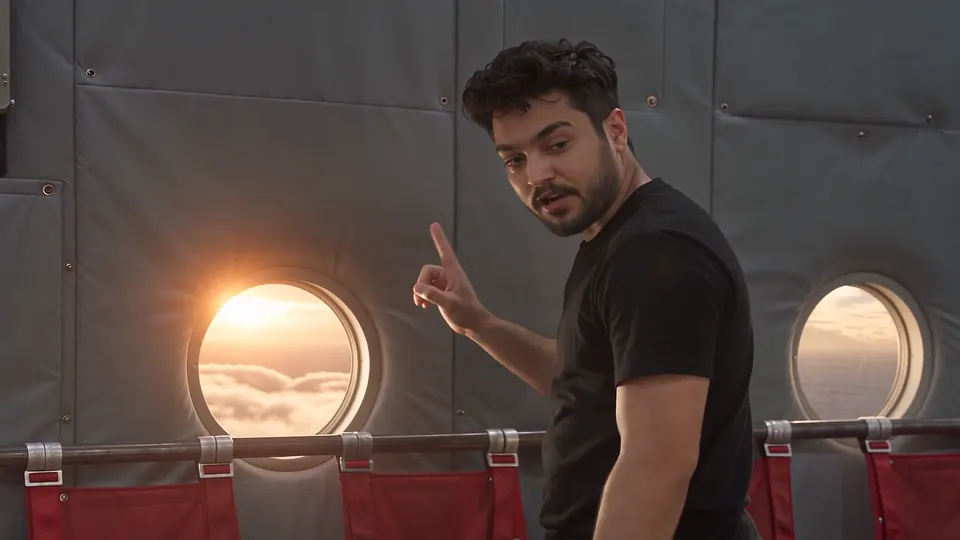
In Agent Social, lip sync is not a step you add afterwards. You say who speaks which line, and each shot is filmed with that character saying it, lips moving with the words, in their own voice, with the sound of the place underneath. Every line in OVERCLOCK, my kaiju series, was made this way.
How do I make an AI character talk with lip sync?
In Agent Social, you make a character talk by putting their line in the scene and filming the shot; the lips come out in sync because the line is spoken as part of the shot, not pasted on later. Start a film and describe the scene in plain words: who is there, where they are, and who says what to whom. The studio writes the dialogue, or uses your exact lines where you give them, and shows you the scene to read before anything is filmed. Each character speaks in the one voice set for them, either one the studio gives them or your own, cloned from a recording. The clip comes back with every line spoken by the right person and the sound of the place under it: traffic, rain, a crowded room. If the delivery is off, say so in one sentence, such as “angrier” or “slower, almost a whisper”, and film that clip again.
Can Agent Social lip sync a video I already have?
No. Agent Social makes new films, so it cannot take a video you already filmed and put new words in someone’s mouth, and it does not re-voice existing footage into another language. If that is what you need, a dubbing tool is the right choice, not a film studio. What Agent Social does instead is film new scenes where the characters speak from the start: invented people, creatures, or you, made from a few of your photos and your cloned voice. That difference shows on screen. Because the line is spoken inside the shot, the face and body move with the words, and the person listening can react in the same moment. A dubbed mouth only moves; a filmed character acts. If you have a story, a script or just an idea for people who talk, the table below shows what you can make.
| You want | In Agent Social |
|---|---|
| A character who speaks their own lines | Yes, filmed in sync as part of each shot |
| Yourself as the speaker | Yes, from a few photos and 15+ seconds of your voice |
| Two or more people in a conversation | Yes, across as many clips as the conversation needs |
| A voice on a phone or radio | Yes, heard from the device, not from anyone on screen |
| Dialogue in Hindi | Yes, Hindi mixed with English, with English subtitles |
| New words on a video you already have | No, it makes new films only |
How do I write a line so the right character says it?
In Agent Social, say who speaks and who they are talking to, the way you would brief an actor, and the studio writes the scene around it for you to read before filming. In OVERCLOCK Episode 5, a soldier from Alpha One hands Kevin a radio and says, “Holiday’s cancelled, sir.” It comes back as one moment: the soldier talking, the radio changing hands, Kevin listening. You do not need special wording for any of this. Ask the way you would talk to the people on a set: “The soldier hands Kevin the radio as he says it. Kevin takes it without smiling.” How the listener takes a line matters as much as the line, because a room of people staring at nothing looks wrong even when every word is right. Read each scene before it is filmed, then watch the clip. If a line comes from the wrong person, say who says it and to whom, and that clip is filmed again.
How do I make two AI characters have a conversation?
In Agent Social, a conversation is filmed across as many clips as it needs, and each clip picks up where the last one ended, with the same people in the same places. A clip runs 4 to 30 seconds and can cut between shots inside it, so a short back-and-forth fits in one clip and a long argument becomes two or three. The listener matters as much as the speaker, so say how the other person takes each line: a laugh, a look away, a hand on an arm. A scene where the listener does nothing looks like two people talking at a wall. In OVERCLOCK Episode 4, the goodbye at the helicopter is just two lines: “Try not to steal another jet ski.” “No promises.” Two short lines, each with someone to hear it, make a whole farewell. Watch each clip before you film the next, because later clips continue from earlier ones.
How do I make a voice come from a phone, radio or loudhailer?
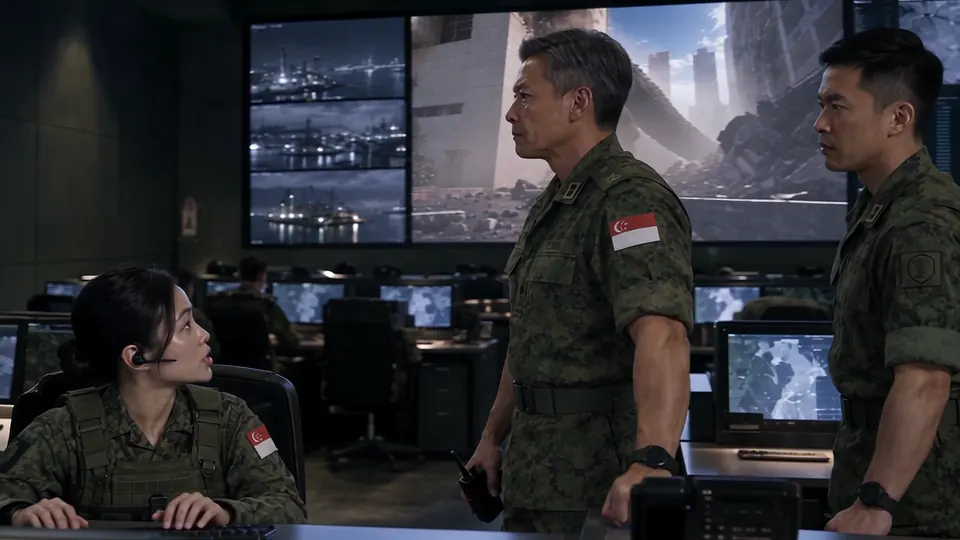
In Agent Social, say that the voice comes from the device and that nobody on screen speaks it, and the line is heard from the phone, radio or speaker instead of out of a face in the frame. OVERCLOCK Episode 5 is full of these voices. Over the radio, Alpha Four reports, “Sir, both cars are gone.” In the operations room, Major Ng’s report comes over the speakers, and Colonel Lim answers, “First, evacuate the area.” On Shenton Way, a police sergeant walks office workers out with a loudhailer: “We are under emergency evacuation.” In each one, the scene says where the voice comes from and who hears it. The same goes for a narrator, a voice on a call, or a television in the background: name the source, and name who reacts to it.
Can an AI character lip sync in my own voice?
Yes. In Agent Social, record or upload 15 seconds or more of your own voice and the studio clones it for your character, who then speaks every line in it, lips in sync, in this film and every later episode. Speak the way the character should sound: if they are calm, record calmly; if they shout a lot, include a few raised lines. A quiet room with no music behind you gives the cleanest result. Pair the voice with a few photos of yourself and the character looks and sounds like you in every shot. That is how I play Deep in OVERCLOCK. Then ask for lines the way you actually talk, because your own voice reading words you would never say still sounds like someone else. Lines can be in English, the default, or in Hindi: everyday Hindi mixed with English, spoken with Indian accents and subtitled in English.
What do I do when a talking clip comes out wrong?
In Agent Social, you fix a talking clip by saying what is wrong in one plain sentence and filming that clip again; the clips around it stay as they are. Most problems are not the voice. They are a missing detail in the scene: nobody said who speaks, who listens, or where a voice comes from. So before you ask for a new voice, read the scene and add the detail. Check every clip against four questions. Did each line come from the right person? Does the delivery fit the moment: shouted, whispered, joking, scared? Do the listeners react, or stand still? Does the sound of the place sit under the voices, not over them? If any answer is no, use the matching sentence in the table. Describe the feeling rather than the volume: “relieved” tells a character far more than “loud”.
| What went wrong | Say this |
|---|---|
| The wrong person says the line | “Kevin says this, looking at Alex.” |
| A radio line comes out of someone on screen | “That line is only heard on the radio.” |
| Everyone talks at once | “Amy waits until Kevin finishes.” |
| Right voice, wrong mood | “Relieved, not loud.” |
| The listener stares blankly | “Joanne laughs before she answers.” |
| The talk sounds rushed | “Spread this over two clips.” |
How long can a talking AI clip be, and what does it cost?
In Agent Social, a talking clip on Seedance 2.5, the default video model, runs from 4 to 30 seconds, and one clip can cut between several shots, like a scene in a film. That is room for a real exchange: the whole operations-room scene in OVERCLOCK Episode 5, a report over the speakers and the colonel’s order, is one unbroken 30-second shot, filmed on the first try. Dialogue and the sound of the scene come with every clip, so there is nothing extra to record or sync. You pay per finished minute of film, with no subscription: about $25 a minute at 480p, or about $45 a minute filmed at 480p and upscaled to 1080p. 480p is the default, and it is enough to judge every line before you upscale. Retakes add to the total, credits never expire, and every charge is listed in your credit history.