To make an AI cartoon series, describe one style in plain words, save it with the series so every episode keeps it, draw your cast once in that style, and write short episodes built on timing. It all happens in one Agent Social chat. Honest note: my own series, OVERCLOCK, is photoreal, and this site has no animated example yet.
What do you need to decide before making an AI cartoon series?
You need to decide six things before the first episode, and every one is easier to settle in words than to fix in footage. The style: how the show is drawn, in one plain sentence. The cast: who comes back every episode, and how each one looks in that style. The voices: one per character, kept for the whole show. The length of a first episode. The shape: wide like a TV show, or tall for phones. The language: English, or Hindi mixed with English. Say all of this once in the studio chat, and the AI TV series maker remembers it, so Episode 6 starts from the same answers as Episode 1. Everything after that is the same path as making any AI TV series, with one extra decision at the very front: how it is drawn.
Name the style
Put it in your first message: the line, the colour, the shading. Films come out photoreal unless you ask, so ask.
Draw the cast once
Check every character’s pictures in that style before anything is filmed. How characters and places are made once.
Cast the voices
One voice per character, or your own. How to cast a voice for every character.
Read the episode
The studio writes it as chapters, one scene each. Change anything in plain words before a single clip is filmed.
Film in order, then finish
Clips are filmed one after another at 480p. Join them, add music and subtitles, then upscale the finished film to 1080p in one click.
What style should an AI cartoon series use?
Use a style you would happily watch for twenty episodes, and describe it in plain words instead of naming a studio or an artist. A good style line names three things. The line: thick black outlines, thin pencil, or none at all. The colour: flat and bright, soft pastels, or muted sunset tones. The shading: none, soft painted shadows, or rounded 3D light. Add the backgrounds if they matter: painted, simple or busy. Simple, bold styles are the forgiving choice for a first series, because a clear outline and a flat colour stay easy to read in fast action and wide shots. Put the style in your first message to Agent Social, because films come out photoreal unless you ask. The same studio makes anime-style series and cartoon series, and the cards below are style lines ready to copy.
Saturday-morning cartoon
Bold outlines and flat colour survive any amount of slapstick, and simple painted backgrounds keep the eye on the characters.
“A hand-drawn Saturday-morning cartoon, thick black outlines, flat bright colours and painted backgrounds: a pigeon who believes he runs the biggest railway station in Kolkata.”
Family film look
Rounded shapes and warm light make even grumpy characters lovable, which suits gentle comedy.
“A soft 3D family-film look, rounded characters, big expressive eyes and warm light: two retired grandmothers who open a detective agency in Goa.”
90s TV anime
Sharp line work and painted skies give drama and action a big feeling without needing complicated places.
“A 90s TV anime look, hand-painted, sharp line work, muted sunset colours: a delivery rider in a rainy future Mumbai who keeps getting mistaken for a hero.”
Handmade clay
Thumbprints and tiny sets make a small story feel crafted and cosy, and slow characters become the joke.
“A stop-motion clay look with thumbprints in the clay and tiny handmade sets: a grumpy snail who runs the slowest café in town.”
Watercolour picture book
Soft washes and pencil lines suit quiet, kind stories told at bedtime pace.
“A watercolour picture-book look, soft washes, pencil lines and paper texture: a lighthouse keeper and the whale who visits him every evening.”
Ink and halftone
Heavy shadows and bold ink give mystery and action a graphic punch that reads instantly on a phone.
“A bold comic-book look, heavy black ink and halftone dots: a night-shift guard at a museum where the statues argue after closing time.”
How do you keep the same cartoon style in every episode?
You keep a cartoon style by deciding it once and storing it with the show, not by describing it again in every prompt. Retyping a style is how a series drifts: one episode’s outlines get thinner, the next one’s colours get softer, and by Episode 4 it looks like a different show. In Agent Social, the style you ask for is saved with the series, the way its cast and places are, so every episode and every shot is drawn the same way without you repeating it. That moves your attention to the very start: look hard at the first pictures of your cast, because every later episode is drawn from the same answers. The next episode can even pick up from the last frame of the one before, with the same characters and the same look. That is the whole difference between a pile of cartoon clips and a cartoon series with one look.
One-off cartoon clips
- The style is retyped in every prompt
- Outlines and colours drift clip to clip
- The hero’s face changes between scenes
- Each video starts from nothing
A series with its style saved
- The style is named once and kept
- Characters drawn once, reused in every shot
- Each character keeps one voice
- Episode 2 picks up where Episode 1 ended
How do you design cartoon characters that look the same in every shot?
Design each character so they are recognisable from their outline alone, then make them once and reuse them. Animators call a character who looks right in every frame “on model”, and it starts with the design: give each one a body shape of their own, tall and thin or short and round, one signature colour, and one thing they always wear or carry. Two characters with the same shape and colour blur into each other the moment they move. Each recurring character is then drawn once in the series’ style, you check their pictures from every side, and every clip they appear in uses them. It is the same method that keeps one face in every OVERCLOCK shot, and it is how consistent characters work in any style. You can even star yourself: a photo of yourself can become a character.
Voices follow the same rule as outlines: a cartoon voice can be bigger than life, so make each one unmistakable, like the pigeon who talks fast and never finishes a sentence or the snail who takes his time over every word, and casting a voice for every character covers how. For a family cartoon made for India, ask for Hindi: the lines come in everyday Hindi mixed with English, spoken with Indian accents and subtitled in English, as the Hindi web series guide explains and Hindi AI movies shows.
How do you write an AI cartoon episode that is actually funny?
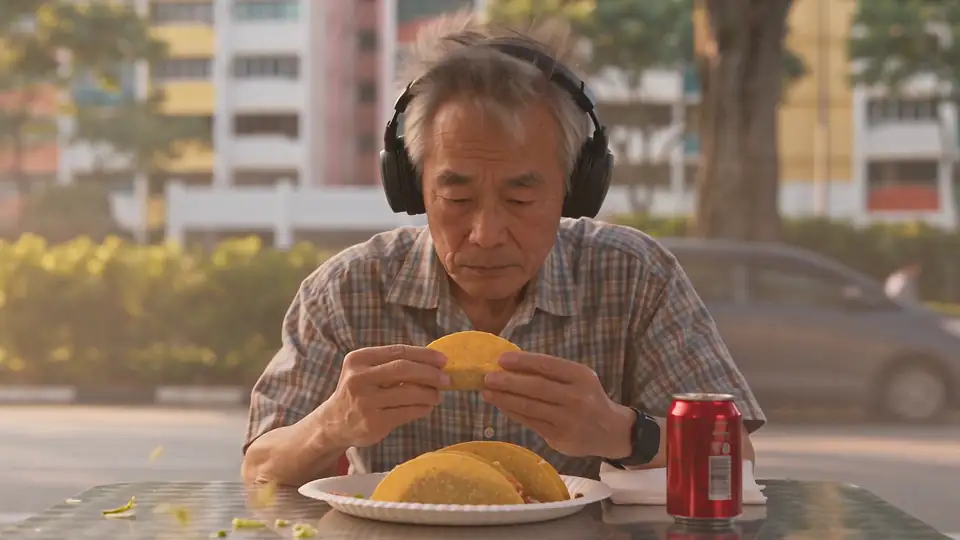
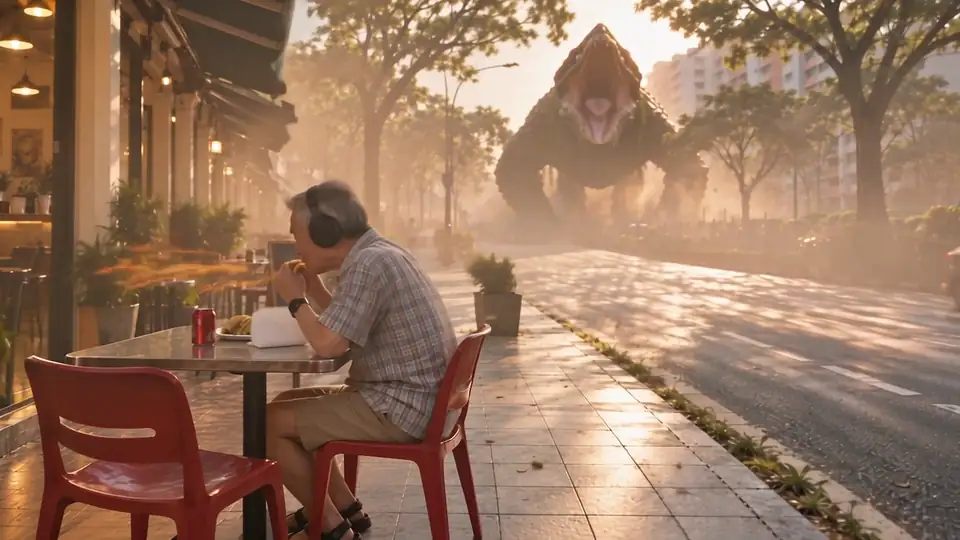
Write for animation: bigger reactions, simpler places, and jokes built on timing rather than on clever lines. A cartoon laugh usually comes from a setup the audience sees before the character does, a pause, and a reaction held a beat too long. Keep each scene in one simple place so the eye goes to the characters, and let them move more than real people would. OVERCLOCK is photoreal, but its funniest scene is built exactly like a cartoon gag. In Episode 4, Double Scoop, Uncle Tan eats tacos with his headphones on while the creature roars down the road behind him. He hears nothing. He bites into an empty shell. Off come the headphones, his song stops dead, and only then does he turn round. It is one 30-second take, used whole, and the making-of page shows it frame by frame. In Agent Social, describe a gag in that order and read the scene before it is filmed.
How long should an AI cartoon episode be?
Start short: a first episode of a few minutes, built around one goal, teaches you more than a long pilot you never finish. Measure it in jokes, not minutes. The taco gag is one whole joke in one 30-second take, five beats from headphones on to the turn, so a three-minute pilot holds about six jokes that size, or one story with three or four big ones and room to breathe between them. Write the jokes first and let the length follow. Clips run 4 to 30 seconds, so a gag that size can be a single clip, and one clip can cut between shots. Pick the shape at the same time: wide like a TV show for YouTube, or tall for phones, and every episode keeps it. A wide episode still gives you tall Shorts later, which turning a film into Shorts and posts covers, and what an AI episode costs has worked prices for a short and a full episode.
Do you have to label an AI cartoon on YouTube?
Usually not, when the whole video is animated and nobody could mistake it for real footage. YouTube’s help page on disclosing generative AI content asks creators to disclose AI-made or altered content that seems realistic, and lists AI animation inside a fully animated video among the things that do not need it. If any scene could pass for real footage, the video is no longer fully animated, so answer Yes under “AI use” in the Attributes section when you upload. Earning money is a separate question. YouTube doesn’t pay for AI videos that look mass-produced or templated, as of November 2026; what YouTube pays for and what it refuses has the full rules. A cartoon with its own cast, and episodes that each tell a different story, is the opposite of a template. Rules change, so check YouTube’s own pages before you upload.
Is your cartoon ready to film?
- Can you describe your style in one sentence without naming a studio or an artist?
- Could someone tell your main characters apart from their outlines alone?
- Have you checked every main character’s pictures in the series’ style?
- Does your first episode fit in a few minutes, with one joke or one goal?
- Have you chosen wide or tall for the whole series?
Answer each question for your verdict.