
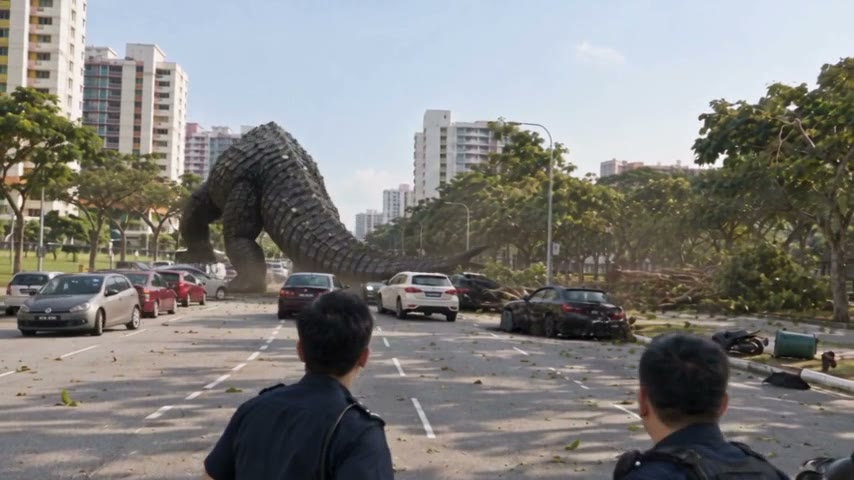
To make an AI story video people watch to the end, let the characters act it out: people who move, speak and keep their faces, in places that stay put, with the sound of the room. In AI story to video, you paste the story or one line, the studio writes it as chapters, and it films every scene.
What is an AI story video?
An AI story video is a short story told as a video made with AI, often a few minutes long and posted to YouTube, Shorts, Reels or Facebook. Most of what goes by that name today is a narrated slideshow: one voice reading a story over a run of still pictures. The kind people watch to the end has scenes instead. Characters move, speak in their own voices and look the same in every shot, the places stay the same, and you hear the room they are in. That is a short film in all but name, and one person with a story can now make it. Every OVERCLOCK episode is a story video in that sense, from an old man eating tacos with his back to a monster to an army command room where everyone is doing something at once.
Why do people stop watching most AI story videos?
Because nothing happens on screen. A voice reads, the pictures change, and the viewer is left to imagine the very story the video was supposed to show. Faces that shift from one picture to the next break the spell every few seconds, and one music track under one voice makes minute four feel like minute one. Viewers stay for what they can watch happen: a face reacting, a hand reaching for a door, a line said to someone who does not want to hear it. So act the story out, in scenes. In Agent Social, each clip is filmed with its characters speaking and the sound of the scene built in, so viewers hear the rain and the slammed door, not only a narrator. There is a money side too: YouTube doesn’t pay for AI videos that look mass-produced or templated, as of November 2026; what YouTube pays for and what it refuses has the full rules.
A narrated slideshow
- One voice reads the whole story
- Still pictures, one after another
- Faces change from picture to picture
- Silence under the voice, or one music track
- Easy to churn out from one template
A story with real scenes
- Characters act it out and speak their own lines
- Moving shots, cut like a film
- The same faces and places in every scene
- The sound of each place: rain, traffic, a door
- Your own story, told scene by scene
One voice over still pictures is an audiobook with wallpaper.
What kind of story works in a short AI video?
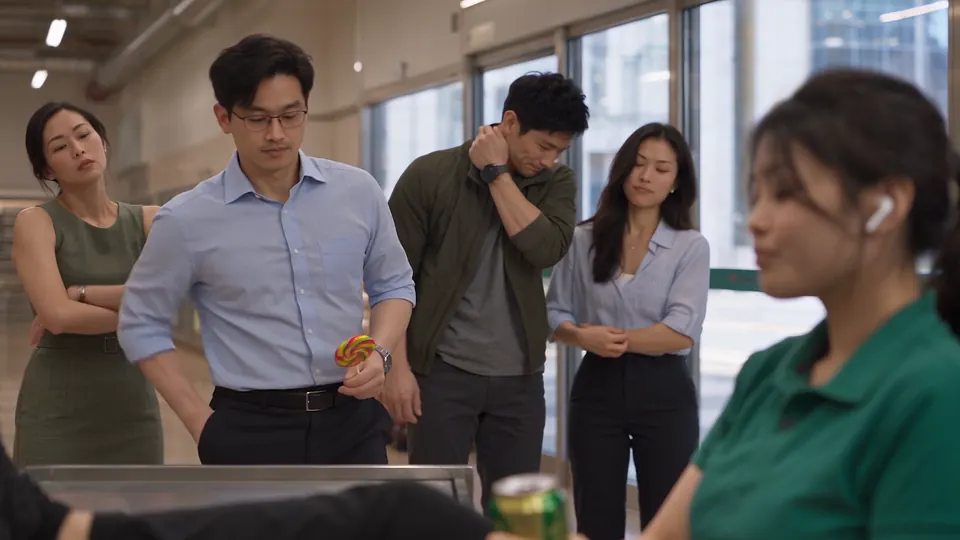
A story with one person who wants one thing, one problem in the way, and one turn near the end. A video of one to five minutes has no room for a slow start or a big cast, so begin close to the trouble, with two or three characters and one or two places. A twist, a moral, a scare or a small human moment all fit, in a real look or a cartoon look. Test it in three sentences: who, what goes wrong, how it turns. If it needs more, it may be an AI TV series instead. OVERCLOCK Episode 5 opens with a scene that works on its own: a cashier who doesn’t care makes a man pay for his lollipop before anyone can run from a monster. Each idea below fits in one video; these channel ideas run longer.
The two-minute twist
A second-hand phone, an old owner’s alarms that seem to know what is coming, and a last line that changes everything before it. Short enough to watch twice.
“Make a two-minute story video: a woman buys a second-hand phone, and the old owner’s alarms start warning her about things before they happen. End on a twist.”
A tale with a lesson
An old-town fable with two characters and one choice. A narrator can open it, then the characters take over.
“Make a three-minute moral tale: a proud spice merchant learns why the old potter never sells his last pot.”
A true-to-life drama
No monsters and no magic: one person on a day that matters to them. Viewers share these because they see themselves.
“Make a four-minute drama: a retired train driver rides the city’s new metro on its first day and meets the young driver who took his route.”
The short scare
One place, one rule, one door that should stay shut. Horror suits a short video, because the dread never has time to wear off.
“Make a three-minute horror short: a hotel night clerk keeps sending the lift to a floor the building does not have.”
A Hindi family story
Three brothers, one old scooter and a lot of opinions. Everyday Hindi with English mixed in, and subtitles so anyone can follow.
“Make a four-minute Hindi family story: three brothers in Nagpur argue over who keeps their late father’s scooter. Add English subtitles.”
How do you turn a story into scenes for an AI video?
Write it as scenes, the way you would plan a short film: for each one, where we are, who is in it, what happens and what has changed by the end. A scene that changes nothing can go. Keep each scene to one place and one moment, and put the dialogue in, because a line a character speaks does more than a sentence read about them. You don’t have to do this alone: the studio turns your story into chapters, one scene each, with the dialogue in, and you can change any scene in plain words before filming starts. The guide to turning a story into a short film walks through every step from there, and the screenplay guide shows how to write a scene that films well. OVERCLOCK Episode 5 tells ten minutes of story in 24 chapters, each one a scene.
Write three sentences
Who, what goes wrong, how it turns. That is enough to start.
Say the length and the shape
Three minutes, wide or tall, English or Hindi. Say it all up front.
Read the scenes
The studio writes the story as chapters with dialogue. Change any scene in plain words before filming.
Check the faces
Every character and place is made once as a picture. Fix a wrong face now and the same face stays in every shot.
Film, finish, post
Clips are filmed in order with voices and sound. Add music and subtitles, download the MP4 and upload it to YouTube yourself, or let Agent Social post it to X for you once you approve.
Should an AI story video have a narrator or dialogue?
Use dialogue for anything the characters can show, and a narrator only where a voice telling the story adds something: a fable’s first line, a diary, a grandmother remembering. Dialogue lets the viewer watch a scene happen; narration tells them it happened, and too much of it turns the video back into a slideshow. The best mix is usually lopsided: a narrated line or two to open or close, and scenes that play out in dialogue in between. In Agent Social you can have both. Every clip comes back with the characters speaking their lines, and every character keeps one voice in every scene and every episode. A narrator is added as a voiceover on top, in your own voice if you like. In OVERCLOCK, dialogue carries the story. If you do want a narrator, casting the narrator’s voice is its own craft.
How long should an AI story video be?
Most AI story videos work best between one and five minutes, and the story, not a target, should set the length. A single twist or scare is done in two minutes. A tale with a turn, two or three characters and a couple of places wants three to five. Plan in scenes rather than minutes: write the scenes first, then see how long they run. OVERCLOCK Episode 4 runs 4 minutes 46 seconds across twelve chapters, each one a scene, so a scene there averages about 24 seconds, and the episode still has room for a monster, a taco and a goodbye at a helicopter. Decide the length before you start, and the shape too, wide or tall, because the film keeps that shape from its first scene to its last. A wide film can still reach phone feeds without being squeezed: turning your AI film into Shorts and posts shows how.
How do you make AI story videos in Hindi (AI story video kaise banaye)?
Ask for Hindi, and the whole story is written and spoken in everyday Hindi with English words mixed in, the way families and offices really talk, with Indian accents and English subtitles underneath. Everything else works the same: the scenes, the same faces in every shot, the sound of each place. Because English is the default, ask before the first chapter is written, not halfway through. Family stories, office comedies, moral tales and village dramas all suit it, because so much of their charm is in how people talk to each other, and the English subtitles open the same video to viewers who don’t speak Hindi. If you plan more than one video, make it a web series, so the family or the office comes back in every episode with the same faces and voices. The guide to making a Hindi AI web series shows how to start one, and the page on Hindi AI movies covers single films.
How do you turn story videos into a series people come back for?
Keep the characters and change the story. Viewers come back for the people, so give them the same family, the same detective or the same village in every episode, with a new problem each time. In Agent Social, every new episode starts with its characters, places and look carried over, so nobody’s face changes between episodes, and it can open on the very frame the last one closed on, which is how OVERCLOCK’s fourth episode carries straight on from the third. Video is $25 a finished minute at 480p, or $45 drafted at 480p and upscaled to 1080p in one click; retakes, writing and pictures use some credits on top (what an AI episode costs). Between episodes, a social media AI agent can keep your X account busy with posts you approve.
What a story series costs: start with five three-minute episodes, then slide to your own plan
- Drafted and finished at 480p$25/minute
- $375
- Then upscaled to 1080p in one click+$20/minute
- +$300
- Finished film in 1080p, in all$45/minute
- $675
15 finished minutes at the published prices. Retakes add to it, and there is no subscription: you pay for what you make.